Containment Boundary Differences
In scientific laboratories and cleanrooms, controlling exposure is critical. Two primary options are Fume Hoods and Glove Boxes. While both isolate processes, they serve entirely opposite functions in operator and product protection.
1. Fume Hood Mechanics: Operator Protection
A laboratory fume hood is an open front-sash ventilation cabinet. It functions by drawing room air into the enclosure and venting it out of the building.
- Air Flow: Room air is drawn in at a constant velocity (typically 0.5 m/s), creating an air curtain that prevents toxic fumes, vapors, and dust from escaping into the room.
- Goal: Solely operator protection. Fume hoods do not protect materials from the room air, exposing the product to moisture, oxygen, and dust.
- Usage: Handling volatile acids, general organic chemistry solvents, and non-sensitive compounds.
2. Glove Box Mechanics: Total Atmospheric Isolation
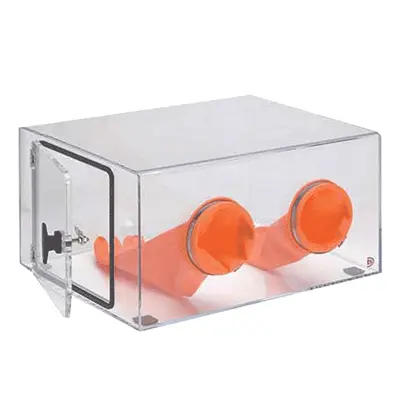
A glove box is a sealed enclosure. The boundary between the operator and the sample is a physical wall of steel, glass, and butyl gloves.
- Atmosphere Control: Ambient air is replaced with high-purity inert gas (Argon or Nitrogen). Purity is maintained via inline filters and chemical catalyst columns.
- Goal: Dual protection. It protects the product from oxidation/hydrolysis (sub-1 ppm O₂/H₂O) and protects the operator from highly toxic APIs, pathogens, or reactive chemicals.
- Usage: Battery research (lithium metal), semiconductor fabrication, and handling hazardous bio-compounds.
3. Comparison Matrix
| Parameter | Fume Hood | Glove Box |
|---|---|---|
| Isolation Type | Open-front dynamic air sash | Hermetically sealed physical wall |
| Internal Gas | Standard room air (humid, oxygen-rich) | High-purity inert gas (Argon/Nitrogen) |
| Sample Integrity | Exposed to ambient air & humidity | Fully protected (sub-1 ppm O₂/H₂O) |
| Operating Cost | Low (Electricity for exhaust fan) | Medium (Inert gas consumables) |